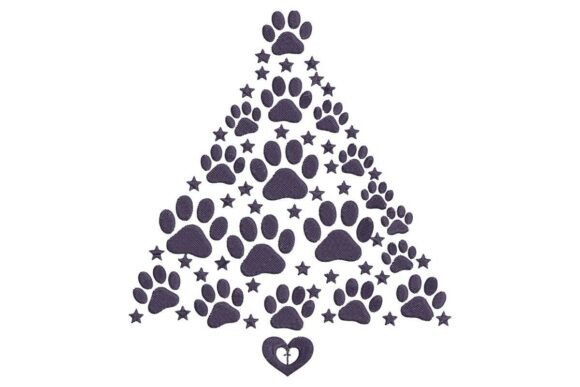
Review: Christian Pet Lover’s Christmas Tree Design
As an embroidery designer who spends more time staring at stitch maps than actual finished garments, I have learned to look past the initial thumbnail appeal. We all know that cute preview image can sometimes hide a nightmare of underlay issues or excessive jump stitches. When I first loaded the Christian Pet Lover s Christmas Tree into my digitizing software, I was looking for two things: clarity of concept and technical viability for real-world production. This design attempts a delicate balance, merging faith-based messaging with the undeniable charm of pet ownership, all within the silhouette of a holiday staple. For those of us running small shops or creating personalized gifts, understanding how this translates from screen to fabric is critical.
First Impressions and Visual Narrative
The immediate mood of this piece is warm and inclusive. It does not scream for attention with aggressive colors but rather invites a closer look. The concept relies on a collage technique, using paw prints to construct the triangular form of a classic Christmas tree. This is a smart approach for holiday embroidery because it avoids the cliché of standard pine needles, offering something that resonates deeply with a specific niche: the Christian pet owner.
From a layout perspective, the design feels balanced. The use of negative space between the paw prints is crucial. If the digits were too dense, the shape would blur into a solid blob, losing the individual character of each print. Conversely, if they were too sparse, the tree shape would fail to read clearly from a distance. In my initial assessment, the spacing appears thoughtful, allowing the eye to travel up the tree while recognizing the constituent elements. This visual personality fits naturally into projects that aim for sentimentality without being overly saccharine.
Real-World Application: The Custom Tote Test
To truly evaluate a machine embroidery design, you must imagine it on a tangible product. I envisioned this design on a natural canvas tote bag design intended for a church holiday market or a boutique pet store. Canvas provides a stable, textured background that can handle moderate stitch density without puckering excessively.
In this scenario, the Christian Pet Lover s Christmas Tree shines as a centerpiece. Imagine a customer walking in with their rescue dog, looking for a gift that acknowledges both their faith and their fur baby. This design bridges that gap. It works equally well on a heavy cotton sweatshirt embroidery project, where the softness of the fleece complements the cozy theme. However, placement is key. On a tote, centering it allows the full silhouette to breathe. On a sweatshirt, you might need to scale it down slightly to fit comfortably over the heart or on the upper back, ensuring the details remain crisp.
Versatility Across Product Lines
Beyond totes and sweaters, this design has legs in several other categories. For baby embroidery, such as a onesie or a receiving blanket, the gentle theme is appropriate, provided the stitch count is manageable for delicate fabrics. It also serves as an excellent candidate for an embroidered patch. Patches allow you to control the backing and stabilizer completely, ensuring a professional finish that can then be ironed or sewn onto jackets, hats, or bags. This modularity makes it a valuable asset for Etsy seller inventories, allowing for diverse product offerings from a single digital embroidery file.
Technical Considerations and Fabric Constraints
While the aesthetic is strong, practical execution requires caution. The collage nature of the design means there are many small, distinct elements. This presents challenges on certain materials. Fabric texture plays a massive role here. On a highly textured towel or a fuzzy fleece, the smaller paw prints might get lost. In such cases, increasing the contrast between the thread and the fabric is non-negotiable. A white thread on a cream towel will vanish; a bright red or deep green on that same towel will pop.
Stretchy fabrics require extra attention. If you are applying this to a knit t-shirt, the movement of the fabric during stitching can distort the circular shapes of the paw pads. Using a high-quality cut-away stabilizer is essential to maintain the integrity of the tree shape. Similarly, when working on curved surfaces like caps, the distortion risk increases. I would advise against placing this specific design on the front panel of a structured cap unless you are experienced with hooping techniques that minimize pull. The vertical height of the tree might also exceed the usable area of standard cap frames, so checking your hoop size limitations is a mandatory first step.
Density and Stitch Types
Without seeing the exact stitch map, one must assume a mix of fill stitch for the larger paw pads and potentially satin stitch or running stitch for outlines or finer details. High stitch density can lead to stiffness, which is undesirable on wearable items like scarves or lightweight shirts. If you are producing a handmade product meant to be soft and drapable, consider testing the design on scrap fabric first. Check if the backside is clean and if the fabric buckles. If the density is too high, you may need to adjust the pull compensation or choose a lighter weight thread.
Commercial Viability and Brand Consistency
For craft business owners, the value of a design lies in its ability to sell. The Christian Pet Lover s Christmas Tree targets a passionate demographic. Pet owners often treat their animals as children, and combining this with faith creates a powerful emotional connection. This enhances the perceived value of the finished product. It is not just a tree; it is a statement of identity.
When creating printable mockup images for your online store, ensure you showcase the design on relevant items. Show it on a mug wrap (if adapted), a pillow cover, or a kitchen towel. Contextual photography helps buyers visualize the item in their homes. Furthermore, consistency in your design assets builds trust. If this design is part of a larger holiday collection, ensure the thread colors coordinate with your other listings. A cohesive shop appearance encourages larger cart sizes.
Final Designer Notes for Best Results
Before committing to a large production run or listing this as a premium custom apparel option, take these practical steps:
- Test on Scrap: Always stitch out the design on the exact fabric type you plan to sell. What looks good on cotton twill may fail on silk or linen.
- Check Contrast: View your design in black and white. If the details disappear in grayscale, they will likely struggle on low-contrast fabric combinations.
- Verify Licensing: Ensure you understand the usage rights. Can you sell the physical embroidered items? Can you share the embroidery file itself? Clarify this before marketing.
- Inspect Small Details: Zoom in on the smallest paw prints. Are there enough stitches to hold the shape? If not, consider simplifying the design for smaller hoop sizes.
- Stabilizer Selection: Match your stabilizer to the fabric. Use tear-away for stable wovens and cut-away for knits to prevent distortion over time.
In conclusion, the Christian Pet Lover s Christmas Tree is a thoughtful addition to any holiday catalog. It respects the nuances of both faith and pet love, offering a unique alternative to traditional motifs. With careful attention to fabric choice, stabilization, and thread contrast, it can become a standout piece in your small shop product lineup. It is a design that rewards precision and offers a genuine connection to the buyer, making it a worthwhile investment for serious embroidery professionals.